

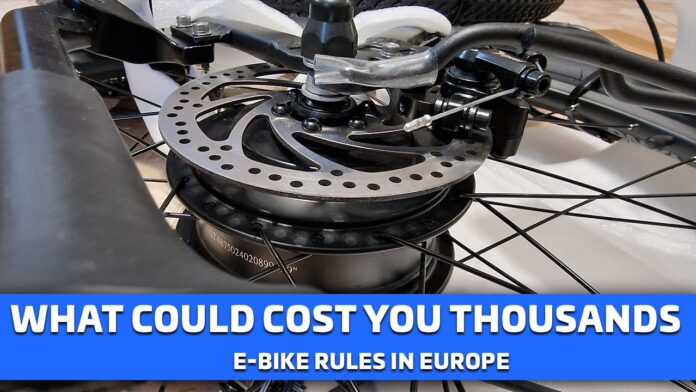
Electric bicycle (you may also often hear another term, namely pedelec) is a great way to get around quickly, but to ride it legally on public roads, it must meet specific legal requirements. The rules have not changed much over the last few years, but plenty of myths have grown around them – what you can do and what you cannot. Which vehicle is legal, and which one must be registered. In today’s video you will learn what a legal electric bicycle means, when an e-bike stops being an electric bicycle, what penalties and obligations apply, and also when a scooter becomes a moped. For your convenience, I prepared time stamps for specific topics in this video. By the way – I will appreciate every subscription, like, and comment – they help me grow the channel and create good content for you. In this video I considered the current regulations in Poland and the applicable EU standards for e-bikes.
What is a legal electric bicycle?
For a vehicle to be treated as a bicycle under the law, and not as a moped or motorcycle, it must fit the definition of a bicycle with electric assistance. So which e-bikes are fully legal?
- An e-bike must have pedal-activated assistance, meaning the electric motor may work only while you are pedaling. This directly means you are not allowed to use a so-called “throttle” to power the bike on its own. In other words, an electric bicycle cannot ride without using human power. (There is, however, one exception to this rule, which I will explain in a moment). It also cannot have a cruise-control function.
- The motor of an electric bicycle may not have a nominal continuous power higher than 250 watts. This is the legal limit – vehicles with stronger motors no longer fall into the category of a regular bicycle. In practice, however, many legal drives can temporarily deliver much higher power – often 500-600 W, and in top models even around 700 W. The key is that during longer riding the average continuous power must not exceed 250 W. This is verified by measuring the motor power over 30 minutes of uninterrupted operation. If it does not exceed the limit and the bike meets the other requirements, it receives certification as an electric bicycle.
- The drive system may be powered by electricity with a voltage of no more than 48 V. Most typical e-bikes meet this condition (typical batteries are 36 V or 48 V).
- The motor may assist pedaling only up to a maximum speed of 25 km/h. After exceeding about 25 km/h, the assistance power should gradually drop to zero so that above this speed the bike moves only by the rider’s leg power. Note: exceeding 25 km/h itself is not prohibited – you can ride faster, but without the motor (that is, like on a regular bike). EU rules also specify that the cutoff should happen smoothly (for example, within a few meters after crossing the limit).
If your electric bicycle meets the conditions above, it is treated as a regular bicycle under the law. This means you do not have to register it or insure it, and no special license is required to ride it (the same rules apply as for a traditional bicycle, including a bicycle card where applicable). You can legally ride such an e-bike on public roads, bike paths, or (in specific situations) even on the sidewalk – exactly the same rules apply as for regular cyclists. Proper equipment also matters – an electric two-wheeler must have everything a normal bike must have (working brakes, a bell, required lights and reflectors, etc.), otherwise you can receive the same fines as for any bicycle.
When does an e-bike stop being a bicycle? More power or higher speed
What happens if our “bicycle” exceeds any of the parameters above? Then – attention – legally it is no longer a bicycle. It may still look like a bike, it may be a converted bike, but it will not fall under the bicycle definition in the road traffic code. Such a vehicle becomes non-standard and is subject to different regulations. In practice, this means it must be treated as a motor vehicle. Interestingly, a seller or store cannot use the term “electric bicycle” for vehicles that do not meet the standards. This may be considered misleading.
Specifically, the law distinguishes the following thresholds:
- An e-bike exceeding 250 W or assisting above 25 km/h = a moped (L1e-B). If your electric vehicle can ride with motor assistance faster than 25 km/h (for example up to 45 km/h) or has power above 250 W (but not exceeding 4 kW), then under the regulations it qualifies as a moped. This definition includes so-called fast e-bikes (S-pedelec) – two- or three-wheeled vehicles with an electric motor up to 4 kW and a design speed up to 45 km/h. Such a vehicle formally is no longer a bicycle, but a moped (even if it has pedals).
- An e-bike exceeding 45 km/h or 4 kW = a motorcycle. If the vehicle’s power or maximum speed is even higher (above the moped parameters), it falls under the motorcycle category and the same requirements apply as for other motorcycles.
Example: An electric fatbike with 1000 W of power, even if it has a speed limiter to 25 km/h, does not meet the definition of a bicycle (because power is >250 W). Such a vehicle should have type approval and registration like a moped in category L1e-A/L1e-B. In Poland, however, hardly anyone registers converted bikes – most of these powerful e-bikes are sold “for use off public roads”. If you want to ride it legally on the street, you must complete the formalities just like with a moped. You can ride such a bike outside public roads.
Obligations for e-bikes outside the bicycle definition (mopeds)
If your e-bike already qualifies as a moped, this comes with additional obligations. Before riding it on public roads you must: register the vehicle, buy mandatory third-party liability insurance (OC), and have the appropriate license (driving entitlement). For a moped, the minimum entitlement is category AM (or higher, for example category B is enough) – previously this was a moped card. In addition, a moped must have a license plate, and the rider must wear a helmet like a motorcyclist. You also have to remember that mopeds (S-pedelecs) are not allowed to use bicycle paths or sidewalks – those privileges apply only to regular bicycles.
Meeting these requirements can be difficult in practice – for example, many electric vehicles that resemble bicycles have no type approval and cannot be registered. That is why, by knowingly riding a non-registered “pseudo e-bike” on the street, you risk legal trouble.
Penalties for riding an illegal e-bike
The rules were tightened in 2022 and fines for not meeting the requirements are severe. Here are possible consequences when using an e-vehicle that does not meet the bicycle definition on a public road without the required licenses and documents:
- Fine for riding on a bicycle path with a vehicle not defined as a bicycle: from 20 up to 3000 PLN. In other words, if you enter a bike path with, for example, a fast e-bike classified as a moped, you risk this penalty.
- Penalty for driving a vehicle without entitlements: at least 1500 PLN (it can be higher – a court may impose a fine up to 30,000 PLN!) and a driving ban from 6 months to 3 years. This applies, for example, when you ride an e-bike that requires AM/B and you do not have it – legally it is treated similarly to driving a car without a license.
- No mandatory OC insurance (for a vehicle classified as a moped): a fine up to 1200 PLN. Besides the ticket, the police may report the lack of insurance to the Insurance Guarantee Fund, which can result in additional administrative penalties.
- Fine for riding on the sidewalk with a motor vehicle: at least 1500 PLN + 8 penalty points. This applies when, for example, someone on a fast e-bike (moped) rides on the sidewalk – it is treated like a motor vehicle offense on the sidewalk.
- Riding without a helmet on an S-pedelec (moped): a 100 PLN fine. For moped-category vehicles a helmet is mandatory, so lack of it results in a penalty (for a regular bicycle, a helmet is still not legally required, though it is recommended).
- Riding while intoxicated: for an e-bike classified as a moped, this is treated like drunk driving a car – you can lose your license for up to 3 years and receive a high fine or even a restriction of liberty.
In practice, the police are increasingly paying attention to electric two-wheelers. There have already been control actions – for example, in Krakow, police officers detained several users of “pseudo e-bikes” over two days whose vehicles exceeded the allowed parameters. Most of them were fined and cases went to court. In short: ignorance of the law is no excuse – it is worth making sure your e-bike meets the criteria, otherwise riding it around the city can cost you.
A scooter can also turn into a moped
Rules for electric scooters are similar in spirit to those for bicycles, but it is worth pointing out one often overlooked issue: a scooter with a mounted seat is no longer an electric scooter under the law! I mention this because I have been seeing more and more of these vehicles on bike paths lately. They are especially popular among older people.
The definition of an electric scooter (Road Traffic Law, Art. 2 point 47b) says it is a two-wheeled vehicle with handlebars, without a seat and without pedals, electrically driven, intended to be ridden only by a person standing on it. Adding a seat changes its classification – a modified scooter stops being a scooter under the regulations. What does it become then? It becomes a moped (as long as it meets the criteria of speed up to 45 km/h and power up to 4 kW).
This creates the same obligations as described above for e-bikes exceeding the norms: vehicle registration, OC insurance, category AM/A1/B license, etc., and a helmet. In practice, almost no seated scooter meets these requirements – it has no type approval, it cannot be registered, nor legally insured as a moped. That is why riding an e-scooter with a seat on public roads is illegal. You can receive, among other things, a 1500 PLN fine (minimum) for driving an unapproved vehicle without entitlements. Moreover, such a scooter absolutely cannot use bicycle infrastructure or sidewalks, because it is no longer treated as a UTO (personal transport device).
In summary: an electric scooter must be without a seat. If you plan to buy a seat for it, it is better to give up, because legally you will turn it into a mini-moped that you should not use on public roads. The Ministry of Infrastructure clearly states that the ban on seats in scooters remains in force due to EU regulations, and no exception is предусмотрено.
Most common questions and doubts
Finally, let’s clear up a few typical doubts about the regulations:
- Can I ride an electric bicycle with a motor bigger than 250 W if I do not use the motor or I ride without the battery? Unfortunately formally no. The law does not distinguish whether the motor is used or not – what matters is what equipment the vehicle is fitted with. If you have a motor above 250 W installed, your vehicle does not meet the definition of a bicycle, even if you ride it “turned off”. The police may consider that you are riding an unregistered moped. Of course, in practice someone may try to explain that they are not using the motor, but this is debatable. To be safe, it is better to have an e-bike that complies with the regulations or remove the excessive drive if you want to ride on public roads without hassle.
- Can you ride an electric bicycle with, for example, a 1000 W motor if it has a 25 km/h limiter?
It is still risky. Although the speed limit to 25 km/h is required, the second barrier is exceeded – the nominal continuous motor power of 250 W. Legally, such a vehicle falls at least into the category of a moped (L1e-B) and requires type approval, registration, mandatory OC insurance, and a category AM license. If it actually exceeds 45 km/h, it becomes a motorcycle.
Some manufacturers offer a “street” mode limiting power and speed, and an off-road mode with full performance. On public roads you can use only the “street” mode, but the switch itself does not exempt you from type approval, because the nominal motor power is several times higher than the permitted 250 W. In other words – formally it is already a motor vehicle, not a “regular” bicycle. If in doubt, the police can detain the vehicle for detailed inspection (for example by an expert) and, if they find no type approval, issue a fine or refer the case to court.
- Is a throttle completely prohibited on an electric bicycle? In a standard electric bicycle it cannot propel the bike above 6 km/h without pedaling. The only permitted exception is the walk-assist (or start-assist) mode – a function that runs the motor up to about 6 km/h and helps, for example, push the bike uphill. If a throttle allows you to ride faster without pedaling, the vehicle no longer meets the bicycle definition and must be type-approved like a moped.
Many imported e-bikes come with a full throttle. Most often it is enough to deactivate it in the controller or limit it in software to walk-assist – you do not have to physically remove the lever itself, because its presence can then be explained precisely by the walk-assist function. The key is that it must not be possible to activate it above 6 km/h without pedaling. Otherwise, riding on public roads will be illegal.
- Do I need a driving license or OC insurance for a regular electric bicycle? No, if your e-bike stays within the 250 W/25 km/h limits and has no self-propelling drive, it is treated like a normal bicycle. A driving license is not required (for adults), and minors should have a bicycle card or category AM/B1 license, just like for a regular bike. OC insurance is not mandatory for a bicycle – it is voluntary. However, for your own safety it is worth considering liability insurance, especially on faster e-bikes. If your vehicle qualifies as a moped, then OC becomes mandatory (as mentioned earlier, lack of it can result in a fine up to 1200 PLN).
- Do I have to wear a helmet when riding an e-bike? Currently, Polish regulations do not impose an obligation to wear a helmet for cyclists of any age – this also applies to standard e-bikes (EPAC up to 25 km/h and 250 W). Still, it is worth wearing a helmet, because it is easy to reach high speeds on an e-bike.
Note: if you ride an S-pedelec registered as a moped, a helmet is legally required (no helmet = 100 PLN fine and 5 penalty points).
What will change? On July 14, 2025, the government adopted a recommendation introducing a mandatory helmet for people under 16. Legislative work is ongoing; the new rules are to enter into force at the earliest at the end of 2025. Until then, the obligation still does not apply to any group of cyclists.
We hope this video helped you understand the legal complexities related to electric bicycles. The summary is simple: if you want to ride an e-bike around the city without stress – stick to the 250 W and 25 km/h limit and do not install a throttle. Then your electric two-wheeler is simply a bicycle and you can enjoy riding like any cyclist. If you need something stronger or faster, be ready for additional legal requirements – or use such a vehicle only off public roads. By following these rules, you will avoid fines and improve safety for yourself and other road users. Ride safe!
