

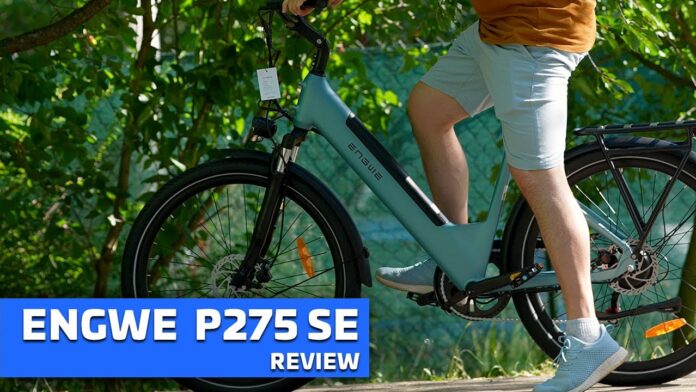
P275 SE is a new model in Engwe’s lineup, featuring an advanced pedal force sensor, a full set of hydraulic disc brakes, great looks, and a fully road-legal drivetrain. How does it perform in real use? What range can you get? How does the assist feel and is it worth buying? That’s what this review is about. The bike has just gone on sale. If you want to buy this model, I added my discount code for 100 EUR off and a direct link to the Engwe store. You get a solid discount, and I get a small commission to keep growing the channel and the blog. Thanks for supporting my projects!
-
DISCOUNT CODE: JOTEM, direct link to the store
First impressions
First contact with the bike and two things immediately stand out: the color and the details. You can buy the P275 SE in two versions – gray or light blue. Both come in a satin finish, right on the edge of matte, which subtly catches the light and simply looks great. The V-shaped frame comes in the base color. The fork, the handlebar with the adapter, the seatpost, the rear rack, and the top-insert battery are all finished in matte black. Looking from the side around the bottom bracket area, you can see a characteristic thickened section of the frame that hides the controller and slightly enlarges the silhouette near the crank. It doesn’t bother me – quite the opposite. The bike stands out among other city e-bikes.
The bike arrives partially assembled, so there’s not much work. I spent the most time on the rear rack, because its mounting is two-piece. You have to loosen the clamp under the saddle and, from the other side, pass the bolt through the rack. Then you need to unscrew the rear fender struts and screw them back in together with the rack mounts. It takes a bit of force, precision, and patience to tighten everything properly and align it. The rest, like the wheel, handlebar, and pedals, went on without surprises. After assembly it turned out the manufacturer had set everything up sensibly. The cables are routed inside the frame, the brakes don’t rub, nothing is loose. All that was left was a quick spin around the block and adjusting the saddle and handlebar height to fit me.
Riding position
Adjustability is a big plus. The stem has a hinge, so I can lower the handlebar by pushing it forward, or raise it and bring it closer, making it easy to dial in ergonomics. At 182 cm tall I quickly found a comfortable, slightly upright position without messing around with spacers. My wife is 170 cm and after a moment of adjustments she was comfortable too, so the range really does cover several heights in the family. The V-shaped frame is a bit like a mini step-through. Out of habit I still often lean the bike and swing a leg over like on a MTB, but if you’re carrying a bag of groceries on the rack, you appreciate being able to get on without acrobatics.
Weight matters, and here Engwe surprised me positively. The spec says 24.4 kg, and in practice you can feel it’s noticeably less than many e-bikes or fatbikes that can be 15-25 kg heavier. That makes it easier to maneuver in front of the house, pop the wheel up a curb, or carry the bike up a few steps. That lighter feel also translates into fun in corners – I like leaning it over, because it tracks confidently and eagerly, without the sensation that the mass is pushing me wide in a turn – and at around 100 kg body weight, every kilogram really makes a difference. It’s also great to ride like a normal bike. You don’t even need to use high assist often to have fun just working the gears on flatter terrain.
Tires and brakes
The tires are very city-oriented. The wheels are 27.5 inches, and the tires are just under two inches wide. There are no balloon tires turning the bike into a pontoon. The narrower profile makes the P275 SE look light and roll quickly on asphalt. I also took it into sand and fine gravel – I felt confident the whole time, the tread holds and doesn’t immediately hunt for grip at reasonable pressure, which is a nice surprise for a city tire.
The braking system is hydraulic 160 mm discs front and rear. The bike stops, but I expected a sharper bite at the levers. I get the impression the calipers are single-piston and the feel is rather soft. You can lock the wheels, but you don’t get that crisp, sporty character I know from the Engwe Engine Pro 2.0, where the brakes feel razor sharp. For everyday city riding it’s enough, although heavier riders could use more adjustment here.
The lighting is complete, but with a caveat. Up front there’s an LED light. It’s not super powerful, but it’s more than enough to make you visible. At the rear there’s a running light, and here I found another downside: no brake light function. On any e-bike it’s really nice to have a light that reacts to braking, because when I’m riding behind someone faster, a brake signal helps predict what happens next. Here, when you squeeze the lever, nothing changes.
Battery and range
The battery slides in from the top into the frame tunnel and it’s one of the smaller ones I’ve ridden with in recent months. It’s a 36-volt system with a capacity of 13 Ah. To remove the battery, you turn the key and it pops out readily. You can charge it both in the bike and separately by taking it home. What’s important is that on paper the battery can seem extremely small. However, the P275 SE has a torque sensor, so the electronics don’t always support you with full motor power. It delivers exactly as much as is needed at the moment. Because of that, with sensible riding, energy use can be significantly lower than on bikes with a simple cadence sensor. I saw similar results in other torque-sensor e-bike tests, where more natural, proportional support translated into longer range and better control in the city.
If you’ve watched my previous e-bike reviews, you know I don’t baby them and I usually ride them as hard as the factory allows. Realistically, on this bike I’m able to maintain a cruising speed around 35 km/h. At my weight – close to 100 kg – on the maximum assist level, I can easily ride about 60 km, which is an excellent result. With calmer riding and lower assist levels, the range increases to 75-85 km.
I have one reservation about the battery. While you need a key to remove it, it’s always on by default. On other e-bikes the batteries have an additional on/off switch hidden in the frame. If you leave the bike for a moment, for example at a store, you can pull the battery out, switch it off, and slide it back into the frame. That makes life harder for a potential thief. Here, the display that activates the assist can always be turned on, and the only way to prevent that is to take the battery with you (which is an unnecessary hassle). The battery’s fit against the frame also needs a slight adjustment, because it’s not perfectly flush and one upper corner sticks out.
Suspension
The Engwe P275 SE is equipped with a suspension fork. It’s a basic spring fork mounted at a slight angle. It doesn’t have the big travel you know from MTB forks. There’s also no lever to make adjusting the damping easier. The saddle is a typical city saddle – slightly flattened – but you can adjust it fore and aft. What I miss is a suspension seatpost. The bike doesn’t have a suspended frame and the tires aren’t as thick as on a fatbike, so at higher speed you do feel some bumps. When rolling off a curb, it’s worth lifting off the saddle. If you often ride over cobblestones, curbs, and potholes, consider swapping to a suspension seatpost – with a rigid frame and relatively narrow tires, those extra centimeters of compliance make a real difference and noticeably improve back comfort on city rides.
Assist on the P275 SE
A torque sensor in the bottom bracket is basically a tiny strain gauge – like a bathroom scale in microscopic form. The aluminum around the axle flexes by just a few microns, and the electronics catch those deformations almost instantly, reading how hard your legs are actually pushing down on the pedals. In the P275 SE that signal goes to the controller, which checks every 20 milliseconds whether you’re pushing harder or softer, and based on that it feeds more current to the motor or cuts it off.
Thanks to that, the bike feels more like an extension of your legs than a scooter with a start-stop button. When you set off from the lights, the assist comes in smoothly, without a jerk. On a climb it discreetly adds watts exactly when your calves ask for help. And on a descent it backs off completely, because the sensor detects the cranks rotating without pressure. That’s why a torque-sensor e-bike feels so natural – unlike cadence-only systems where the motor wakes up only after a few chainring teeth and not always when you actually need it.
In practice, the assist on the P275 SE feels like a smooth, steady push that doesn’t try to replace your legs – it discreetly adds the missing percentage, which makes the whole ride surprisingly natural.
The motor on this bike is rated at 250 W and the torque is 43 Nm. It’s fully legal for public roads. The torque figure seems fairly low, but for city riding on relatively even routes, the assist works surprisingly well. On level 5, during hard sprints from a stop, you can feel strong support. When you hit a bigger hill, even the highest assist level won’t save you and you’ll need to drop to easier gears and work your legs hard.
The bike is limited to 25 km/h by default, but it’s possible to remove that limit – I’ll show you how in a separate video.

