

Some devices are not designed to rescue a poorly lit shot. They will not replace a large studio light, illuminate an entire room, or suddenly turn night into day.
What they can do, however, is something completely different. They can make an ordinary wall look far more interesting, give a product a more engaging setting, or use light to subtly separate a person from the background. Sometimes, it is precisely this small accent that makes a simple shot look much more professional.
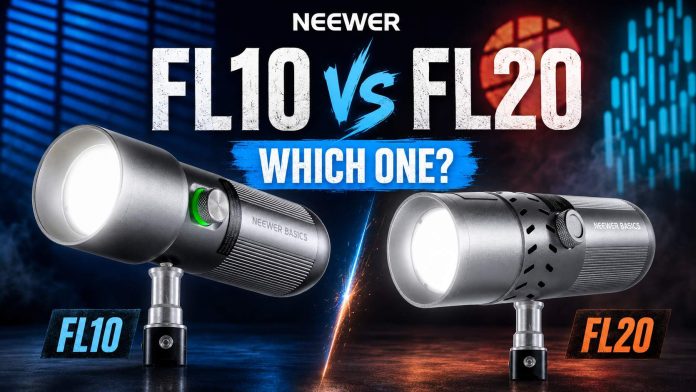
The NEEWER BASICS FL10 and FL20 were designed for tasks like these. The manufacturer calls them photography flashlights. I would describe them more as small, portable effect spotlights with an adjustable beam and the ability to project GOBO patterns.
The smaller FL10 is rated at 10 W, while the larger FL20 offers 20 W. It might therefore seem that all you need to do is look at the numbers and choose the more powerful model. In practice, however, the differences are more complex.
The FL20 is brighter, has better fit and finish, and produces more pleasing color tones, but it does not look as though it is emitting twice as much light. The FL10, meanwhile, is lighter and quieter and may be the better choice for close-range work.
NEEWER provided both lights directly to me for this comparison. All the differences described below are based on my hands-on testing of both units.
I show the complete comparison, examples of the colors, beam adjustment, and the GOBO filters in my video:
NEEWER FL10 vs FL20 Specifications
| Specification | NEEWER FL10 | NEEWER FL20 |
| Rated power | 10 W | 20 W |
| Maximum illuminance | 1,620 lx at 0.5 m | 3,000 lx at 0.5 m |
| Measurement conditions | 2000 K light | 2000 K light |
| Brightness adjustment | 1-100% | 1-100% |
| Available colors | 4 | 4 |
| GOBO filters | 20 | 20 |
| Beam angle adjustment | Approx. 10-60 degrees | Approx. 10-60 degrees |
| CRI/TLCI for white light | 95+/96+ | 95+/96+ |
| Battery capacity | 27.75 Wh | 49.95 Wh |
| Claimed runtime | Up to 180 minutes | Up to 180 minutes |
| Charging time | Approx. 270 minutes | Approx. 270 minutes |
| USB-C input | 5 V/2 A | 5 V/3 A |
| Mounting points | Three 1/4-inch threads | Three 1/4-inch threads |
| Dimensions | 155 x 53.5 mm | 177 x 52 mm |
| Weight | 416 g | 543 g |
Design, Mounting, and Build Quality
Both models take the form of a metal flashlight with a large lens at the front. The FL10 weighs 416 g, while the FL20 weighs 543 g. The larger model is therefore 127 g heavier, although I would not describe either of them as particularly heavy.
The lights can be held in one hand, packed into a camera bag, or mounted on a stand. Each has three standard 1/4-inch threads. One is located on the bottom and the other two are on the sides. This lets you position the light vertically or horizontally, or attach it to a photographic arm.
I would have liked to see a simple clamp included in the box. I would immediately pair a light like this with a super clamp and a small ball head. This makes it possible to mount the light on a curtain rod, shelf, stand, desk, or virtually any other object outside the frame.
Positioned in this way, the light can serve as a rim light, illuminate someone’s hair during an interview, or create a colored pool of light on a wall.
The FL20 performed better in terms of fit and finish. In my FL10 sample, the lens assembly had a tiny amount of play and produced a faint rattle when the light was moved. The front section can be unscrewed, but I could not find a way to tighten the optics themselves any further.
I do not know whether this issue affects every FL10. I consider it an observation about my particular sample rather than a fault affecting the entire product line. The FL20 I tested was properly assembled and did not produce any similar sounds.
Adjustable Zoom and Beam Control
Both lights feature mechanically adjustable zoom. By extending the front section containing the lens, you can change the beam angle from approximately 10 to 60 degrees.
This lets you create either a small, intense spot or a considerably wider beam. The mechanism provides a pleasant amount of resistance. It takes a little force to change the setting, but this prevents the barrel from moving on its own when the light is mounted at an angle.
This feature gives both models an advantage over basic LED panels. Instead of flooding the entire area with light, you can direct it precisely at a selected section of a wall, product, or person.
In practice, the FL20 illuminates the center of the beam more strongly. The FL10 distributes relatively more light around its edges. The difference therefore concerns not only brightness, but also the way the lens distributes the light.
Is the FL20 Twice as Bright as the FL10?
No. The FL20 is noticeably brighter, but visually it does not look like a light that emits twice as much output.
NEEWER claims 1,620 lx for the FL10 and 3,000 lx for the FL20. Both figures were measured at a distance of 0.5 m using the yellow 2000 K light.
The FL20 has twice the rated power and an illuminance figure that is approximately 85% higher. However, the increase from 1,620 to 3,000 lx corresponds to roughly 0.9 stop of exposure.
This difference is noticeable to a camera, but the human eye does not perceive it as a doubling of brightness. It is also important to remember that the manufacturer’s figure applies to the most powerful yellow mode rather than every available color.
The FL20 provides more headroom and is more capable when illuminating a subject from a greater distance. You should not, however, buy it expecting it to look twice as bright as the FL10.
Do the NEEWER FL10 and FL20 Offer True RGB Lighting?
No. The RGB label may suggest that you can select virtually any color, but both models offer only four preset colors.
The lights use separate LEDs that produce:
- warm white light,
- red light,
- blue light,
- orange-yellow light.
The colors cannot be mixed. You cannot select green, purple, turquoise, or a specific shade that matches your set or your channel’s visual identity.
This is a noticeable limitation for me because I often use blue light that leans slightly toward purple. Here I am restricted to the preset blue, which also looks different on each model.
On the FL20, the blue is darker and deeper, with what looks like a subtle hint of cool white. On the FL10, it leans more noticeably toward cyan or teal.
The white light also differs. The FL10 has a noticeably greener tint. The FL20 contains less green and shifts slightly toward red or magenta. The FL20 gives me a more pleasing and neutral-looking result, particularly when matching it with other lights.
A high CRI does not automatically guarantee an identical white tint. It primarily describes how accurately the colors of illuminated objects are rendered, not the absence of a green or magenta shift in the white light itself.
Interestingly, the two models also use a different color switching order. If you turn on the FL10 and FL20 at the same time and start pressing their dials, they will not activate the same colors at the same moment. This makes no difference when using a single unit, but it can be frustrating when trying to synchronize a pair.
The GOBO Filters Are the Highlight of the Kit
Each model comes with 20 GOBO filters. They can project patterns of windows, blinds, leaves, dots, geometric shapes, and other decorative motifs onto a wall.
Combined with the adjustable zoom, they provide plenty of creative possibilities. You can simulate light coming through a window, add texture to a portrait, make an empty wall more interesting, or highlight a product.
The darker the surroundings, the clearer the pattern becomes. In a brightly lit room, the GOBO pattern may disappear, especially when using the FL10.
The filter mounting system could have been designed better. First, you place the silicone attachment over the head. You then bend the filter slightly and push its tab through a relatively small opening.
Changing patterns quickly is awkward. The filter has to flex, and bending it too far could eventually damage the tab. A wider opening that allowed the filter to slide in and then lock into place by rotating the attachment would be much more convenient.
The kit also lacks a simple diffuser. A small frosted attachment would soften the beam and make the lights more useful for close-up photography of small products. The silicone snoot controls the beam and holds the GOBO, but it does not replace a softbox.
The FL20 Produces a Faint Noise
When the FL20 is switched on and held close to your ear, you can hear a faint, constant noise. It resembles a small fan running inside the housing.
I did not disassemble the device, so I cannot confirm which component is responsible for the sound. The noise is present even when the light remains in standby mode and the LEDs are not illuminated.
It is easy to miss from a normal distance. It may only become an issue if the light is positioned very close to a sensitive microphone in a quiet room.
The FL10 also emits a minimal amount of noise, but you have to listen very carefully to hear it. The smaller model is therefore the safer choice when recording very quiet scenes with a microphone positioned close to the light.
Battery Life and USB-C Power
Both lights have built-in batteries. The FL10 offers 27.75 Wh, while the FL20 provides almost 50 Wh.
Despite the FL20 having twice the rated power, NEEWER claims up to 180 minutes of runtime at the maximum setting for both models. A full charge takes approximately 270 minutes, or 4.5 hours.
The lights can be charged and powered over USB-C. They also work with a power bank, which makes them more practical when shooting on location.
I did notice, however, that brightness can drop slightly when using an external power source. In the case of the FL20, this may partly be explained by its 5 V/3 A input, which can deliver a maximum of approximately 15 W while the light itself is rated at 20 W.
The built-in battery means you can take the lights on an evening shoot, use them somewhere without access to a power outlet, or quickly build a lighting setup for a product shot.
These are not devices that can overpower strong sunlight. The FL10 will be practically invisible in full sun. The FL20 offers more headroom, but it also works best in shade, after dark, or under controlled conditions.
The Controls Are Simple as Long as the Light Is Within Reach
All functions are operated with a single dial. Rotating it adjusts brightness, a short press switches colors, and holding it turns the light on or off.
As long as the light is in your hand or mounted on a small stand, this system is simple and convenient.
The problem begins when the light is mounted high up, behind the person being filmed, or in another hard-to-reach location. Once you return to the camera, you may discover that it is too bright. You then have to walk back to the light, change the setting, and return to the camera.
Neither model offers an app or remote control. Remote brightness adjustment and color switching would be among the most useful improvements NEEWER could make in the next generation.
What Can You Use the FL10 and FL20 For?
The NEEWER FL10 and FL20 work best as effect lights rather than as primary light sources.
They can be used as:
- rim lights,
- hair lights,
- colored accents on a wall,
- spotlights for product photography,
- GOBO pattern projectors,
- supplementary lights during an interview,
- lighting elements for B-roll,
- portable lights for photographing electronics, food, bicycles, models, or other objects.
Technically, you can try to use them as key lights, but this is not what they do best. The beam remains relatively hard, output is limited, and the lack of white balance adjustment makes matching them with other lighting more difficult.
If you need a primary studio light, a larger fixture with a Bowens mount and softbox will be a better solution.
The FL10 and FL20 should be treated as additions to a larger lighting kit. A single, carefully positioned pool of light can give a flat and uninteresting background more depth. That is where these lights demonstrate their greatest potential.
NEEWER FL10 or FL20: Which Model Should You Choose?
Who Is the FL10 For?
The FL10 is lighter, quieter, and considerably cheaper. It should be sufficient for close-range work in a dark or moderately lit room.
It is a sensible choice for someone who occasionally wants to illuminate a product, wall, or part of a background. It will also work well when the light needs to be positioned close to a microphone.
Who Is the FL20 For?
The FL20 has better fit and finish, a larger battery, larger LEDs, and a more strongly illuminated center of the beam. It also produces a more pleasing white and a deeper blue.
It is not visually twice as bright, but it does provide more headroom. You can place it farther from the subject, run it at a lower output, or use it in a slightly brighter environment.
I generally prefer to buy a more powerful light and dim it when necessary rather than later trying to squeeze extra brightness from a weaker model. For that reason, I would choose the FL20 out of these two.
Where Can You Buy the NEEWER FL10 and FL20?
At the time of writing, the FL10 cost EUR 59.99 in NEEWER’s European online store, while the FL20 was priced at EUR 102.99. Prices and availability may change.
The FL20 costs approximately 72% more than the FL10. That premium does not give you twice the brightness, but it does provide more output headroom, a larger battery, better fit and finish, and more pleasing color tones.
Are the NEEWER FL10 and FL20 Worth Buying?
Both models make sense if you need a small, portable effect light with an adjustable beam and GOBO filters.
The FL10 is the more sensible choice for someone looking for an affordable accessory for occasionally illuminating products and backgrounds. It is also quieter and lighter.
The FL20 wins in build quality, brightness, beam distribution, battery capacity, and color tones. It is not without flaws, however. You still get only four colors, with no white balance adjustment, app, remote control, or diffuser. Changing the GOBO filters also remains awkward.
These are not lights around which I would build an entire studio. They are accessories you can throw into a bag and pull out whenever an ordinary shot needs more character.
If that is the kind of portable effect light you are looking for, both models can be very useful. The FL10 is the more economical option, while the FL20 is more versatile and is the winner of this comparison.
FAQ
Can the NEEWER FL10 and FL20 Replace a Studio Light?
No. These are primarily small effect lights designed to illuminate a background, product, hair, or the edge of a subject. A larger light with a softbox will be a better choice for illuminating an entire person or room.
Is the FL20 Twice as Bright as the FL10?
The FL20 has twice the rated power, but visually it is not twice as bright. The claimed illuminance increases from 1,620 to 3,000 lx, which corresponds to approximately 0.9 stop of exposure.
Are the FL10 and FL20 True RGB Lights?
No. Both models offer four preset colors and do not allow them to be mixed. You cannot select arbitrary shades of green, purple, or turquoise, and you cannot adjust the white balance.
How Many GOBO Filters Are Included?
Each model comes with 20 GOBO filters. They can project patterns including windows, blinds, leaves, dots, and geometric shapes.
How Long Do the FL10 and FL20 Run on Battery Power?
NEEWER claims up to 180 minutes of operation at maximum brightness for both models. A full charge over USB-C takes approximately 270 minutes.
Can the Lights Be Powered by a Power Bank?
Yes. Both models can operate from an external USB-C power source. During testing, however, I noticed a slight reduction in brightness, particularly with the more powerful FL20.
Which Model Should You Buy?
Choose the FL10 for occasional close-range use, especially if a lower price and quieter operation matter to you. The FL20 is the better option if you want more brightness headroom, better build quality, and a larger battery.

