

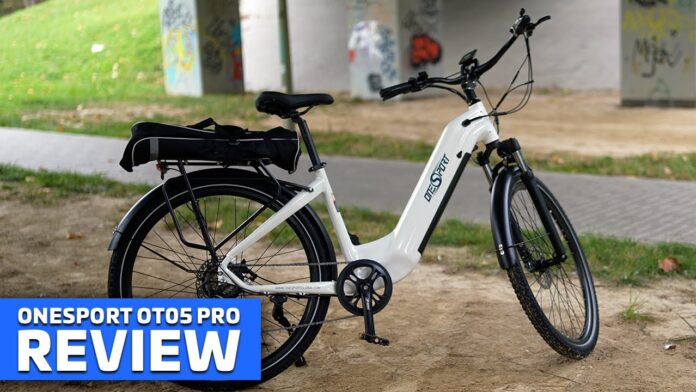
If we judge only by looks, the OneSport OT05 Pro could easily compete with much more expensive e-bikes. But in the world of electric bikes, not everything is about what’s on paper or in the catalog. This model can both impress… and frustrate just as easily. In this review, I’ll share how the OT05 Pro performed during my tests. To start, I should mention that the bike was sent directly by the manufacturer for review – thank you for supporting my channel and blogs! You can support me too by subscribing – thanks!
The box looked like a small fridge, and inside – everything neatly packed. The bike comes partially assembled, so you only need to do the usual: mount the front wheel, handlebar, pedals, and accessories. It quickly turned out this wouldn’t be a completely effortless job: the rear rack arrived slightly bent (you can see it in the video), and some of the bolts were so tight that a wrench wasn’t enough – I had to use a power drill. Not a dealbreaker, but if you expect to be ready in 15 minutes, here you’ll realistically spend some extra time fine-tuning the setup.Once assembled, I stood the bike on its wheels – and immediately, point to OneSport: clean frame design, integrated battery, excellent paintwork, and internal cable routing. No messy wires, no “garage build” feel. Visually, it’s urban, modern, and tidy. I really liked that first impression.
Ergonomically, the situation is similar. The cockpit features a “butterfly” handlebar and an adjustable stem that allows you to change both angle and height. The adjustment exists but is somewhat limited – around 30 degrees. For me (182 cm, 100 kg), that’s a bit too little. I’d like to raise the handlebar slightly higher and pull it closer; if you go past the adjustment scale, the cockpit starts to feel loose. It’s perfectly fine for everyday use, but if I were keeping the OT05 Pro for years, I’d definitely replace the stem with one offering a wider range – I bought a similar one for my Duotts C29 for about 7 euro.
Then I got on the bike. First kilometer – and a smile. This isn’t a cadence-sensor bike that needs a full pedal rotation to start and then pushes with 100% power like it’s on autopilot. Here, the torque sensor rules – it reacts instantly. The harder you press, the more assistance you get; ease off, and everything quiets down and flows naturally. That makes a huge difference in the city because the ride feels genuinely smooth and intuitive. There are three assist levels – “1” for casual cruising, “2” for daily commutes, and “3” for faster stretches or small hills. Once unlocked, the bike reached about 33 km/h on flat ground with my weight – perfectly fine to keep up with traffic or open up on an empty road.
Brakes? Hydraulic calipers with 180 mm rotors do their job well. The braking power and modulation are genuinely good, giving a strong sense of control and safety. I did, however, struggle with the front brake during setup: the rotors are not only large but also quite thick, leaving only a 1–3 mm gap inside the caliper. Adjusting it “by ear” is a precision job. At first, there was rubbing and squeaking, but after a few adjustments and several kilometers of riding – all good. The final result: predictable, confident braking without drama.
Tires? Classic city-style, not oversized balloon types. The profile suits asphalt and hard-packed paths, giving the bike a stable, composed feel without wobble or sluggish cornering. They’re 27.5-inch wheels with reflective sidewalls – a good urban choice with low rolling resistance and solid grip. You don’t need to think about traction every time you turn. To complete the setup, the bike includes full lighting – front, rear, and a brake light. That last one might sound minor, but in real traffic, it greatly improves communication with drivers and other cyclists. If you like having everything ready “out of the box,” this bike delivers exactly that.
Now, let’s get to the heart of the matter – the motor. The specs are honest: 250 W rated power, but if you dig into the motor manufacturer’s data (Ananda), you’ll find that peak output reaches only around 350 W. So no, it’s not a powerhouse – and it doesn’t pretend to be. For smooth city riding, it’s fine. The problem starts under sudden or heavy load. The motor can cut out completely for 2–3 seconds, come back with power for a moment, then cut again for another 2–3 seconds – repeating this cycle three or four times until it “recovers.” You feel it as a series of short jolts, like someone lightly tapping the brakes repeatedly. It happens especially when you push hard or hit even a mild incline (well below the claimed 30% grade). And that’s frustrating, because that’s exactly when you need consistent support.
I like having full control – with the Engwe P275, I could simply increase the assist level and power through almost any hill. The motor had punch and elasticity. Here, sometimes even a small slope means I already know: I’ll have to get off and push, because at some random moment, I’ll lose all assistance. In my opinion, OneSport should use a stronger motor or recalibrate the controller’s safety limits so it doesn’t shut down so aggressively in critical moments.
In everyday use, though, you’ll appreciate the rest of the package. Full equipment right from the box – fenders, rear rack, lighting, and kickstand – means you don’t need to buy extras. The riding position is upright, wrists stay relaxed thanks to the “butterfly” handlebar, and the seat height adjustment has enough range for riders of various heights. If not for the limited handlebar angle adjustment, there would be little to complain about in terms of ergonomics.
It’s also worth noting that the bike is relatively light – just 29 kg, and the battery can be easily removed for charging. That’s a big advantage in everyday life – you don’t have to carry the whole bike into your apartment or office.
During testing, I found one more, in my opinion, poor design choice. The rear fender is bolted to the frame from the inside. Sounds minor, until you try to remove it – to reach the screws, you need to take off the entire rear wheel with the motor. Anyone who’s ever changed an inner tube in a hub-motor e-bike knows how frustrating that can be. I mention this because the bolts tend to loosen slightly from vibrations. After just a dozen kilometers, the bike started to rattle like a toolbox. It couldn’t be fixed on the road – there’s no space to get a finger or a wrench in there, the gap between fender and tire is too narrow. Eventually, one screw completely fell out with its washer, and that was the end of it. On the plus side – at least the rattling stopped. Still, it’s the kind of avoidable issue that affects the overall impression. Simply moving the fender mounts to the outside would have solved it completely.
And finally – the price. Under 900 euro for a fully equipped urban e-bike with hydraulic brakes, torque sensor, neat frame design, and full lighting? That’s a very good deal. Especially if your priority is comfort and hassle-free city riding, not chasing performance records. Compared to the Engwe P275, the OneSport feels larger, more “grown-up,” and a bit more stable. I actually find it more comfortable to sit on than the Engwe, which until now was one of my favorite bikes. The P275 is smaller, easier to fine-tune ergonomically, and when needed – simply more dynamic. If your heart beats faster at the thought of sprinting or powering up a bridge “full throttle,” the Engwe fits that role better.
Verdict? The OneSport OT05 Pro is a solid urban companion: it looks premium, rides smoothly thanks to the torque sensor, brakes effectively, and comes ready to roll right out of the box. For lighter riders or those commuting mainly on flat city roads, it’s a smart, reliable, and fairly priced choice. But there’s one major drawback – the motor behavior under load. That repeatable pattern of short 2-3 second cutouts, brief recovery, and more cutouts – 3 or 4 cycles in total – until the system “unlocks” again. I don’t like losing control at such critical moments. So, if you want a bit of adrenaline, reliable uphill power, and that extra kick under your feet, it’s worth spending a bit more on something stronger. But if your goal is calm commuting, recreation, and simplicity within a under 900 euro budget, the OneSport OT05 Pro makes a lot of sense.
You can buy the bike directly from the manufacturer – the link and discount code are in the video description. I’ll receive a small commission, and you’ll get the bike at a lower price. Thanks for supporting the channel!

