

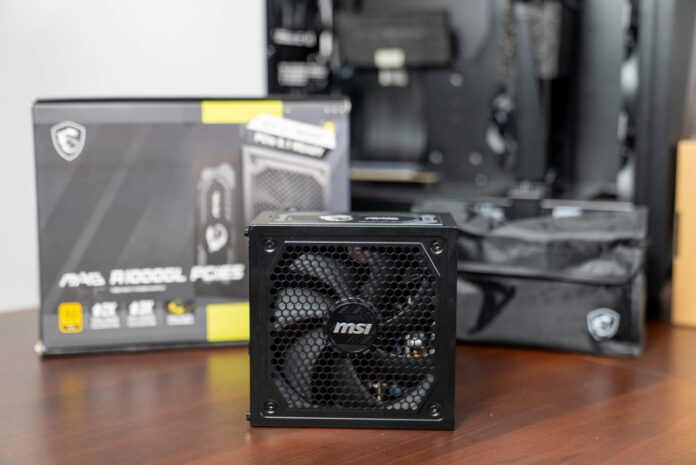
When building a high-end PC, we often focus on the processor and graphics card, but the power supply is the silent hero of every system. In my newest build – powered by an AMD Ryzen 9 9950X3D – I went with the MSI MPG A1000GS PCIe 5. It’s a 1000-watt unit from MSI’s top MPG lineup, meant to meet enthusiast demands. MSI has only recently been pushing more strongly into the PSU market, but it has already made its presence felt with models carrying 80 Plus Gold certifications and the modern ATX 3.0/3.1 standard. Did the A1000GS handle the load of my PC, and is it worth its price?
I received the unit for review directly from the manufacturer. Thank you for supporting my channel and blog.
Specifications and build
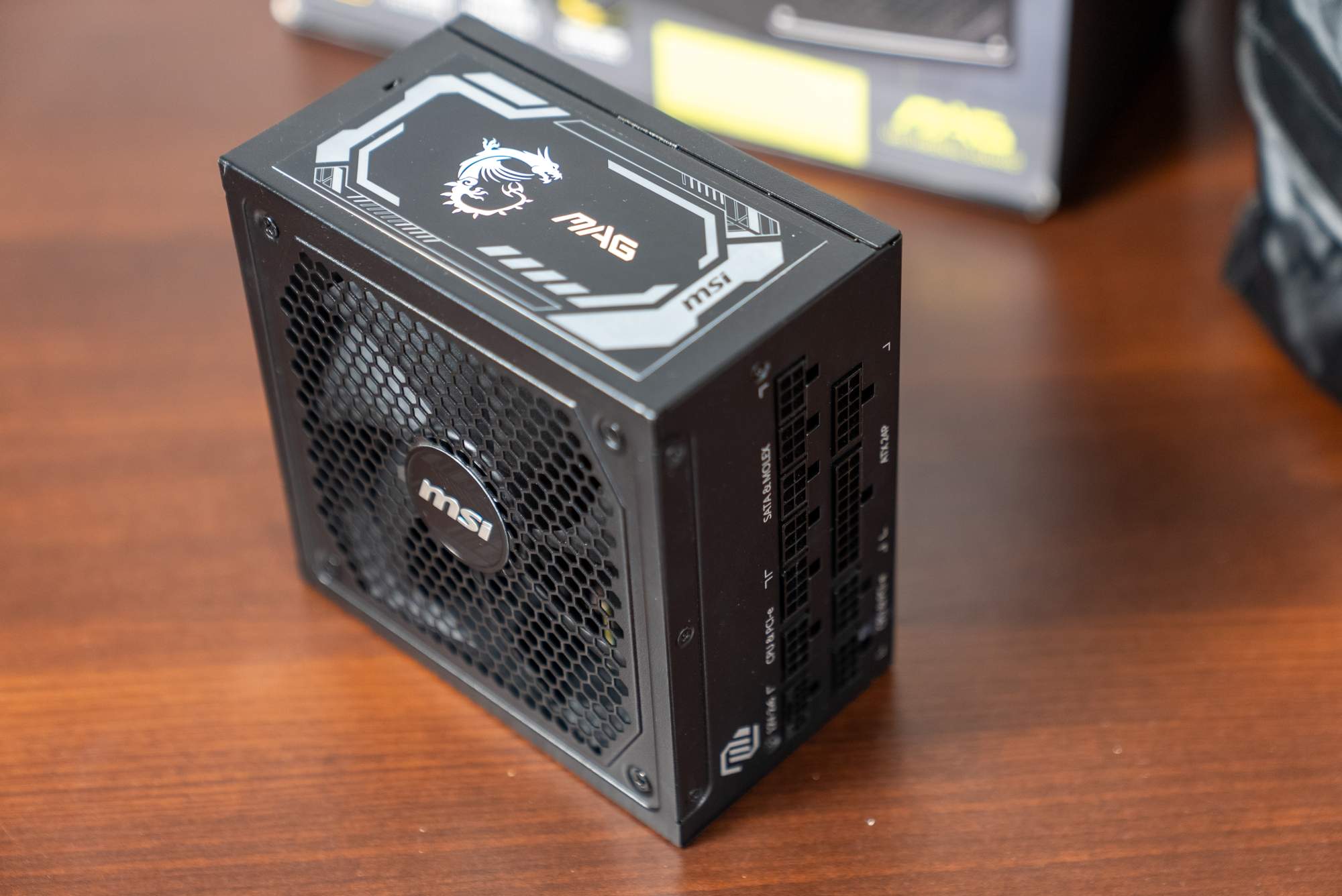
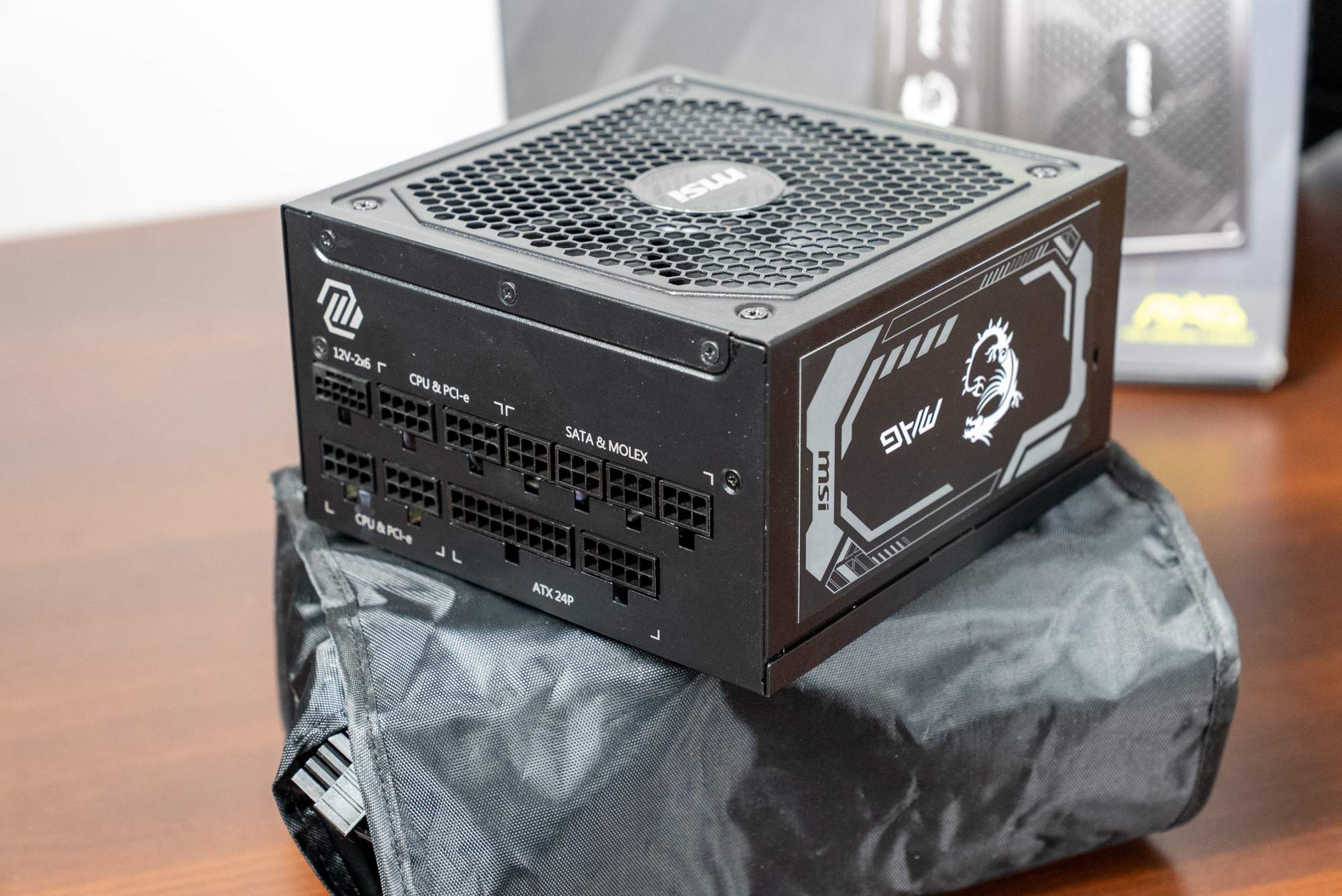
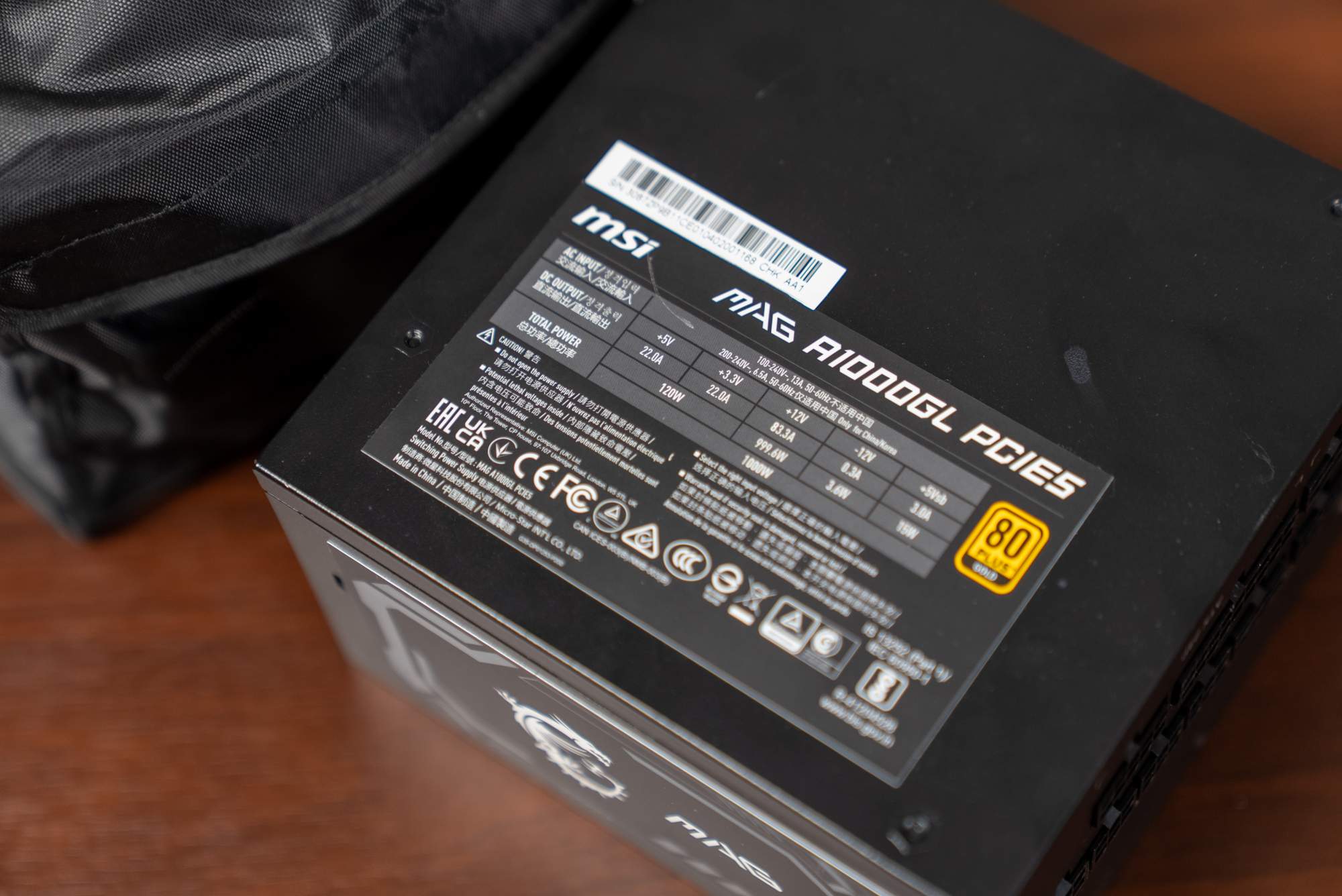
MSI MPG A1000GS PCIe 5 is a fully modular power supply with a continuous output of 1000 W, certified 80 Plus Gold (and also Cybenetics Gold, around 91% efficiency at typical load). The “PCIe 5” marking indicates it was designed for the ATX 3.0/3.1 standard, confirming compatibility with the latest graphics cards and their sudden power spikes. At first glance, the build quality looks solid – the casing has a compact 150 mm length, so the A1000GS fits even in smaller cases without forcing cables in. The design is modern and consistent with the MPG line: a black housing with geometric embossing and elegant side panels with the MSI logo. A nice touch is that these metal badges are magnetically attached and can be rotated, so the logo always stays in the correct orientation regardless of how the PSU is mounted. It’s a small detail, but a great one for aesthetics-focused builders who care about how their PC interior looks.
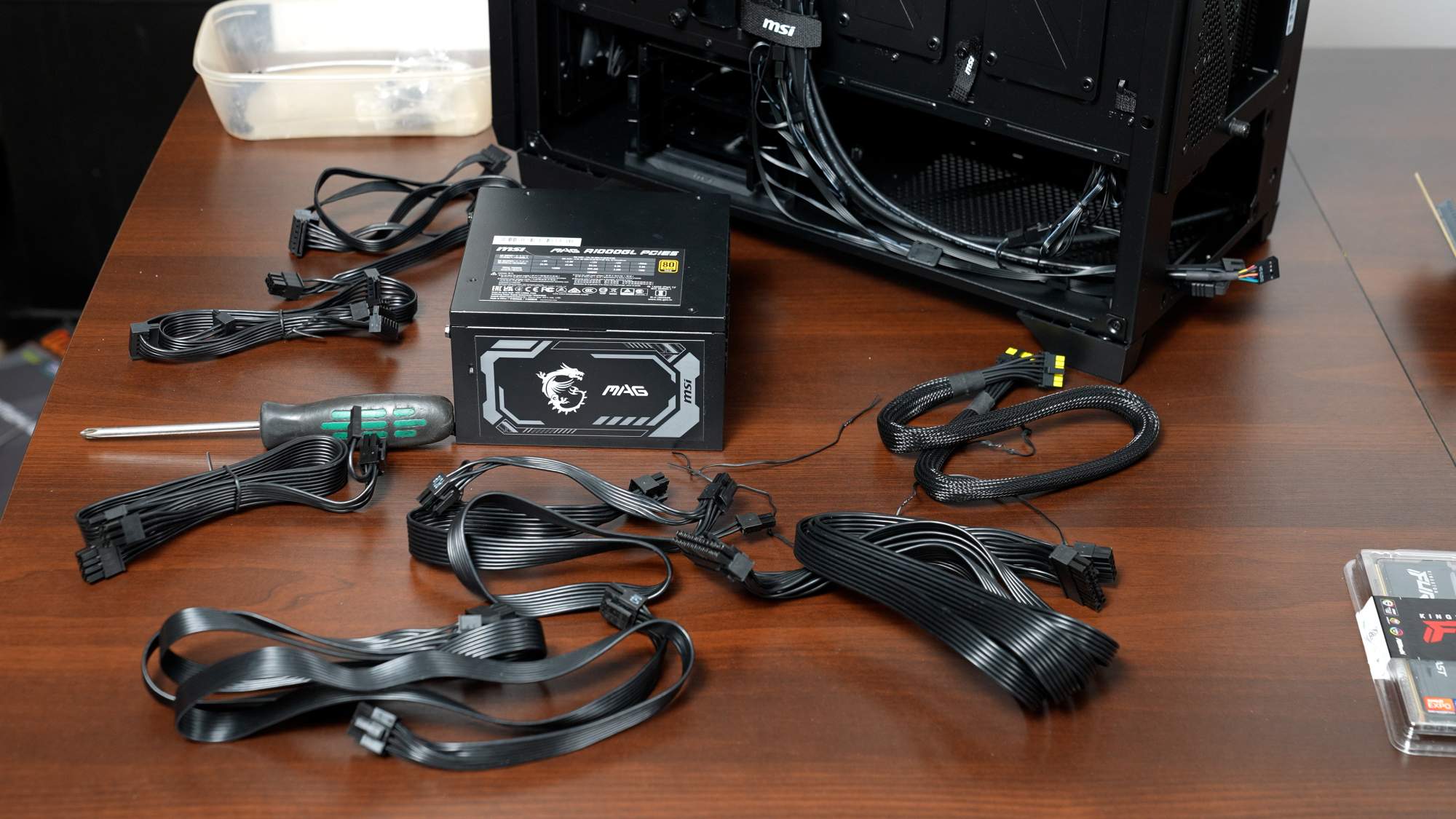
Inside, you’ll find a platform from the well-regarded OEM CWT (Channel Well Technology), packed with high-end components. MSI didn’t cut corners on quality: Japanese 105°C capacitors (including Nippon Chemi-Con and Rubycon) are used on both the primary and secondary sides. Voltage regulation is very tight, which translates into stable power under all conditions. This solid design is backed by a 10-year warranty.
Standout features and what’s new
The biggest highlight of the MPG A1000GS is its PCIe 5.0 readiness. In practice, that means you get two 12+4 pin 12VHPWR connectors (so-called 16-pin) directly from the PSU. That’s unusual in this wattage class – very few 1000 W PSUs natively include two such cables. Thanks to this, the unit is ready for the most power-hungry next-gen NVIDIA cards. If a future GPU requires two 16-pin connectors, this MSI model can handle it. Of course, 1000 W isn’t enough to fully load both connectors at 600 W each simultaneously, but having that headroom gives you more flexibility, for example with setups using two moderately demanding cards or one extreme card with two power inputs.
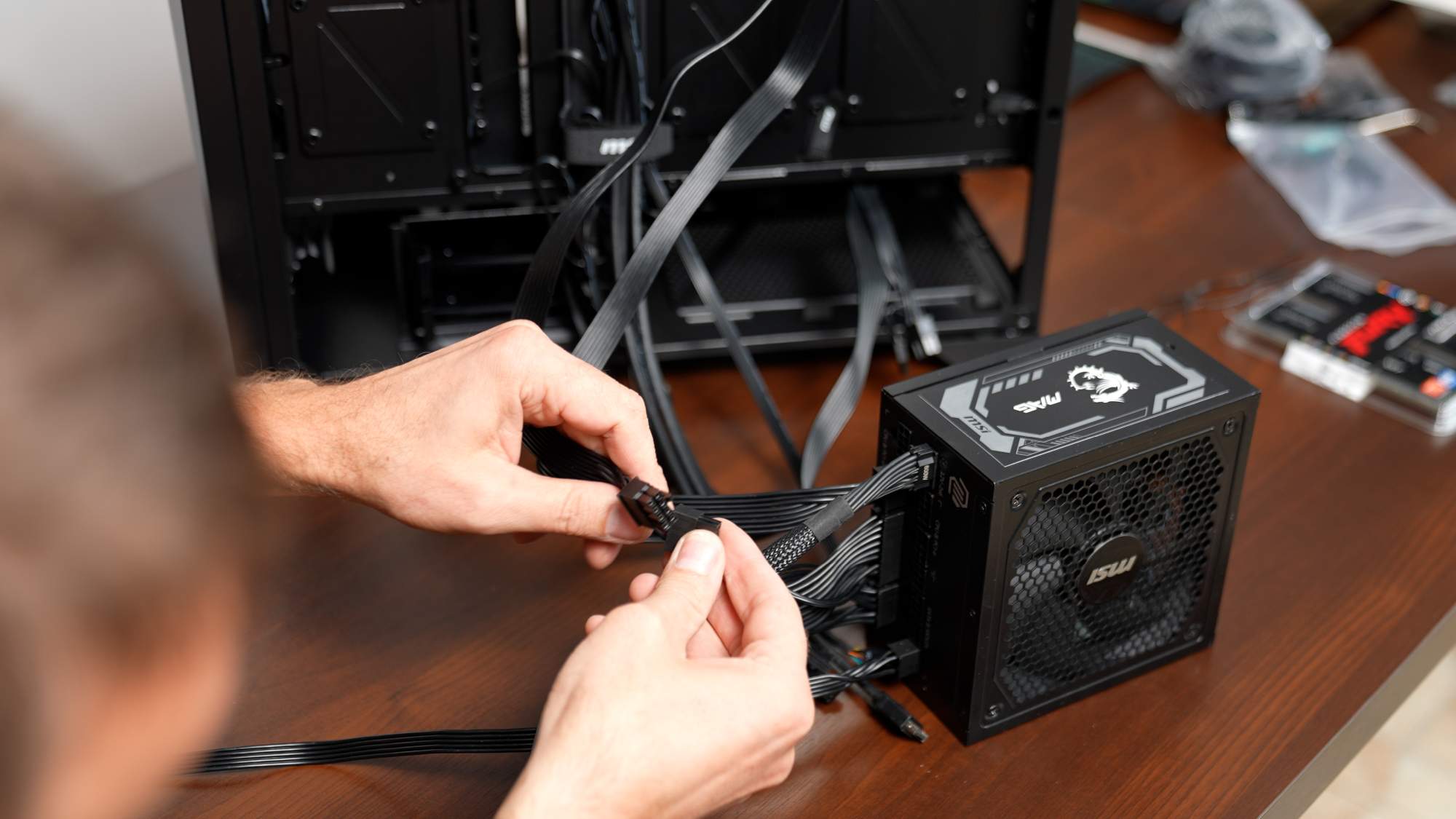
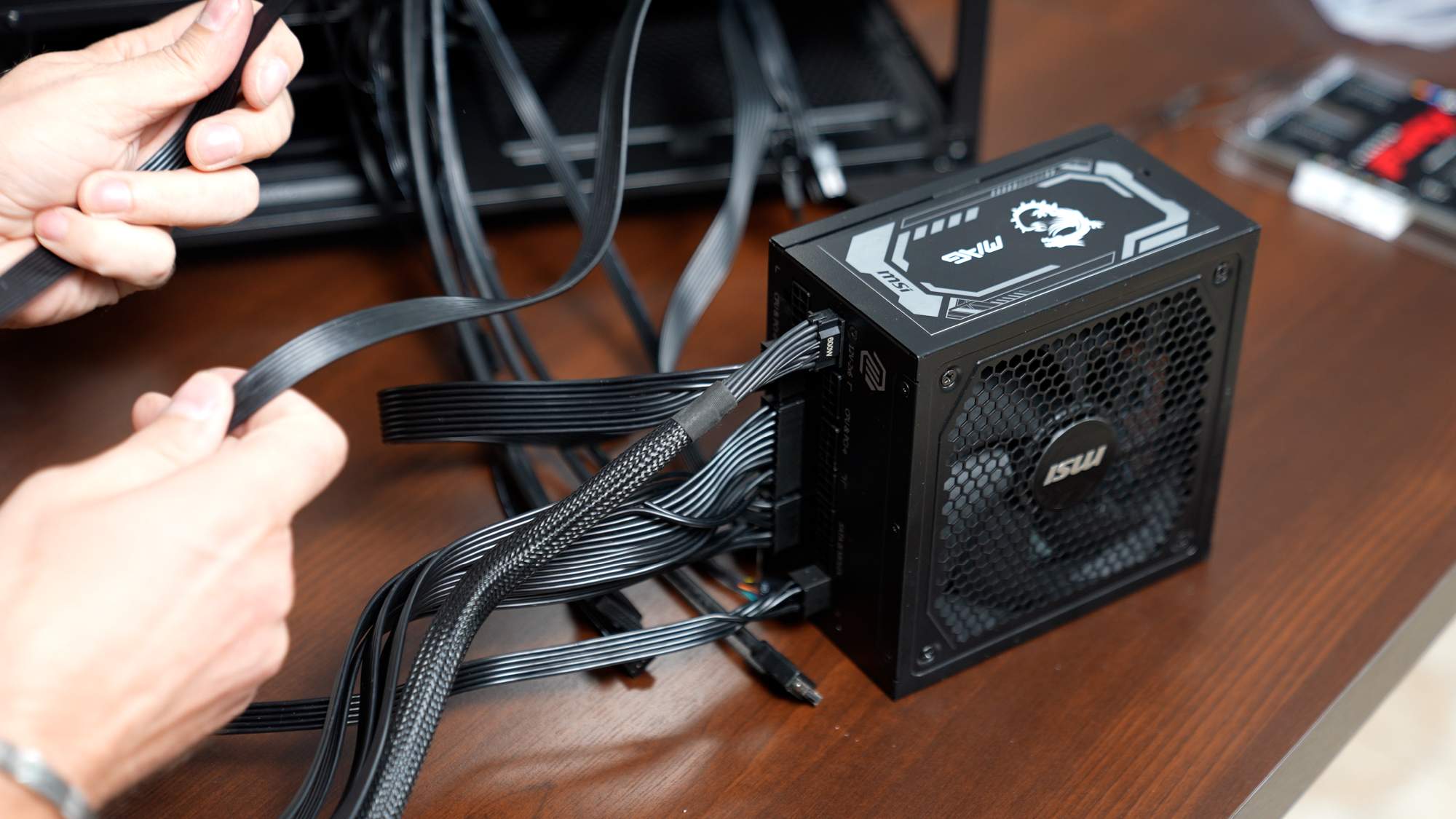
While MSI was generous with the new connectors, its approach to older PCIe cabling is surprising. In the box you’ll find only one cable with traditional 6+2 pin plugs for graphics cards (a single cable run includes two 8-pin plugs). In other words, there’s no second PCIe 8-pin cable. For NVIDIA owners, that’s not an issue (newer GeForces use 16-pin anyway, and older ones typically needed at most two 8-pin plugs). But if someone plans to use a high-end AMD Radeon card, they might be in for a surprise. Many high-end Radeon models (such as some non-reference RX 7900 XTX cards) have three 8-pin connectors, which you can’t power with this PSU without workarounds. You simply can’t connect a third plug – the lack of a second cable prevents fully cabling such a card. When I looked through opinions on international forums, quite a few people called MSI out for this, even suggesting the company is favoring NVIDIA at the expense of AMD enthusiasts. And there’s some truth to that – MSI (at least for now) doesn’t produce its own AMD graphics cards, so it apparently decided AMD owners aren’t the target audience for this product. It’s a shame, because including a simple 12VHPWR to 2x 8-pin adapter would have solved the problem.
Let’s look at cooling – here MSI is also keeping up with modern expectations. The A1000GS uses a 135 mm fan with an FDB (Fluid Dynamic Bearing), known for durability and quiet operation. Importantly, the PSU offers a semi-passive mode: up to about 30-40% load, the fan doesn’t spin at all, delivering absolute silence during office work or movie watching. This mode is enabled via a switch on the back – MSI labels it “Zero Fan Mode.” In my performance-focused build, it doesn’t change much because the AIO is the main audible element anyway, keeping the Ryzen 9 9950X3D at low temperatures. But in a more typical setup, the PC can remain virtually inaudible. Only under prolonged load (video rendering, gaming) does the PSU fan start spinning gently. What’s worth emphasizing is that even under heavier load, this model remains exceptionally quiet. That silence comes from a rather conservative fan curve – MSI chose lower RPM at the cost of somewhat higher internal temperatures.
Drawbacks and shortcomings
No piece of hardware is perfect, though. After longer use and reviewing feedback from other reviewers, a few downsides of the MSI A1000GS stand out and are worth mentioning. The most obvious one is the limited cabling for AMD graphics cards, which I already covered. The lack of a second 8-pin cable is a rather odd decision by MSI, and as a result this 1000 W PSU isn’t suitable for builds with top-tier Radeons that require 3x 8-pin. Of course you can argue that most enthusiasts go with NVIDIA anyway, but for a PSU in this class I’d still expect full universality. Personally it wasn’t a problem because I use an RTX 4080, but a potential buyer with a Radeon may get an unpleasant surprise. It’s a shame, because a small addition to the cable set would have satisfied both camps.
The second downside is the price relative to performance. MSI priced the A1000GS at around 190 USD (in Poland roughly 900-1000 PLN), putting it in the upper segment of 1000 W Gold PSUs. While I understand you’re paying for new standards (ATX 3.1, two 16-pin cables, digital PFC control) and the MSI brand, competitors can deliver similar quality for less. For example, PSUs like the NZXT C1000 or Corsair RM1000x (also ATX 3.0) often cost a few hundred PLN less, while offering higher efficiency or a similar noise profile. The Hardware Busters team noted during their tests that the platform used by MSI isn’t among the most efficient: efficiency under full load drops to about 90%, while some competing units hold 92-94%. The differences aren’t huge, but at this price you’d expect top-tier performance, while the A1000GS is “only” very good rather than exceptional. In short, the performance-to-price ratio could be better. Personally, I think you’re paying a bit of a novelty and brand premium here. If you’re building an all-MSI ecosystem (case, motherboard, GPU, as in my case), it can make sense. But from a purely practical standpoint, you can find strong competitors at the same price, especially if you don’t need two 16-pin cables.
Another point I noticed (and that comes up in other reviews) is the fairly high temperature under load caused by the ultra-quiet fan profile. As I mentioned, even at full power the PSU remains relatively quiet, but there’s a trade-off. The interior heats up quite a bit (simple physics: lower RPM equals higher temperatures). The components are rated for 105°C, so around 60-65°C at the exhaust isn’t dangerous. For me it’s not an issue because my case has excellent airflow. Still, you’d like a bit more balance. I think MSI could have implemented fan failure protection, but unfortunately it’s missing. If the fan were to fail one day, the user might not notice, and the PSU could overheat.
The last small nitpick is more about aesthetics and what’s included. For a higher-end product, the A1000GS is fairly minimal in extras. In the box, besides cables and mounting screws, you won’t find things like cable ties, a PSU tester, or even stickers. These are small details, but at this price it’s nice when manufacturers include something extra. On the other hand, you do get the cable organizers and the magnetic panels, so it’s not bad. It’s also worth noting that while the PSU itself looks great, the number of modular outputs is smaller than usual for a 1000 W unit (a result of the reduced PCIe cabling). The back panel simply has a few blocked-off spots. It doesn’t affect functionality, but during installation it caught my eye that “something is missing.”
Summary – is it worth buying?
The MSI MPG A1000GS PCIe 5 turned out to be a power supply that met my expectations for powering an ultra-demanding PC, while also pleasantly surprising me with its noise profile. It’s a unit designed for modern systems – ideal for configurations with the latest NVIDIA GeForce RTX cards and powerful processors like Ryzen 9 or Core i9. Its biggest strength is silence: in everyday use, you can practically forget your PC has such a powerful PSU inside. Add full modularity, excellent build quality, Japanese components, and a long warranty, and you get the picture of a premium product meant to run reliably for years.
So, is it worth buying? Yes, but not for everyone. If you’re building a top-tier PC focused on the quietest possible operation and you want to future-proof yourself (ATX 3.1, power headroom, cables for new GPUs), the MSI A1000GS is an excellent choice. NVIDIA owners in particular will appreciate its capabilities and hassle-free integration. In my case, it fit perfectly into an MSI ecosystem (case, motherboard, GPU, and PSU from one brand), giving a sense of consistency and quality. The power supply stably powers my RTX and Ryzen monster while producing no unwanted noises.
On the other hand, if you’re counting every penny or you use or planned to use a top-end AMD card powered by 8-pin connectors, it’s worth considering alternatives. Competitors often offer similar wattage and standards for less money, and the lack of extra 6+2 pin cables on the MSI unit can be limiting in certain scenarios. This PSU is aimed at a specific segment – enthusiasts who prefer the latest standards and quiet operation, and who are willing to pay extra for the MSI logo and a few unique touches.
Personally, I’m happy with it, because my priorities were clear: high acoustic comfort, power headroom, and future-proofing. The MSI MPG A1000GS PCIe 5 delivered on those promises with room to spare. It could be cheaper and more universal, but within my build it performed отлично. That’s why I rate it as a power supply worth considering for demanding users, although before buying it’s a good idea to make sure it fits your specific needs and configuration, especially in terms of cabling. If it checks those boxes, go for it – it’s a solid investment in the heart of your PC.

